Please wait while page loads... This should be < 1 minute on a 56k modem
Recycle Fraction - Cost
General Information
Physical Insights
Example Uses
Simple Questions
Further Questions
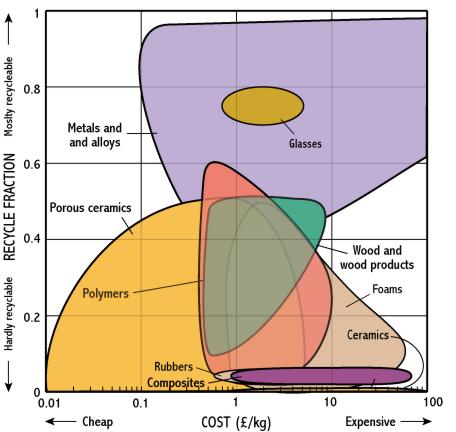
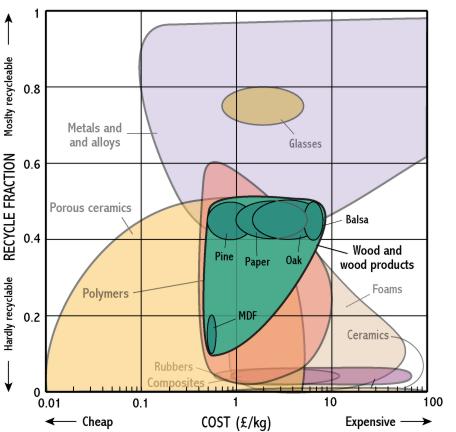
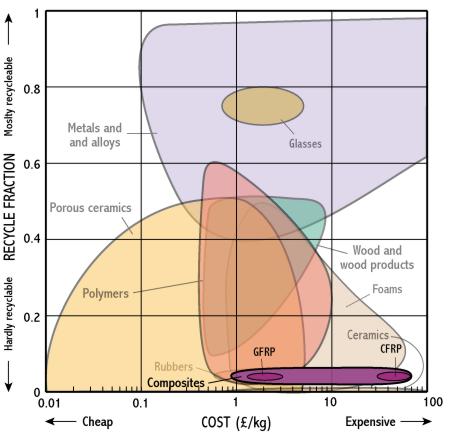
This chart gives a useful for a first look at the trade-off between environmental concerns over excessive waste disposal and the cost penalty.
General Information
The fraction recycled is that fraction which can be recycled cost-effectively.
High recycle fractions are not necessarily achieved at present.
Recycling involves returning the material to its raw form, but re-use (e.g. returnable milk bottles) is sometimes more energy efficient.
This chart is useful for identifying materials which are heavily recycled, and exploring those which are not.
Naturally great efforts are made to recycle expensive materials (few diamonds are ever thrown away!).
Physical Insights
Despite high costs, composites prove difficult to recycle – most are based on thermosets, which cannot be remelted, and in all composites it is difficult to separate fibres and matrix
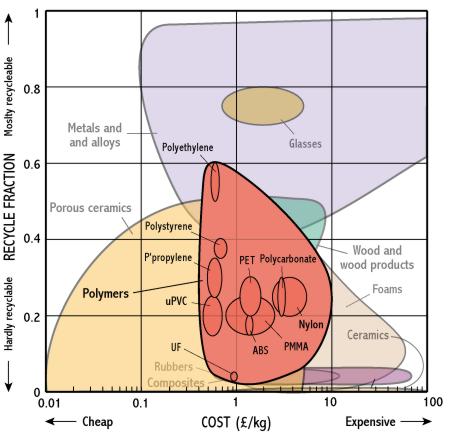
Thermoplastics are often used interchangeably (making separation difficult) or used in low density, large volume objects (such as bottles) making recycling costly
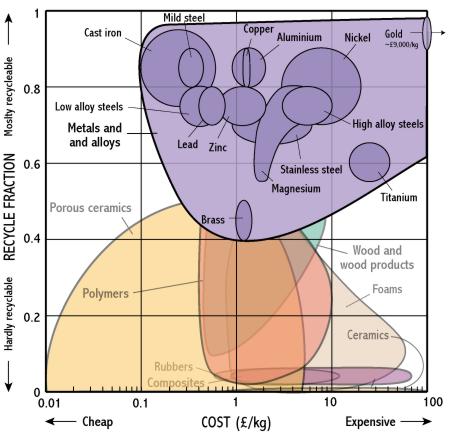
Metals are particularly suited to recycling as they can be easily sorted, remelted and shaped; they are often used to make large or uncomplicated/plentiful objects (e.g. ships, cars, drinks cans, piping)
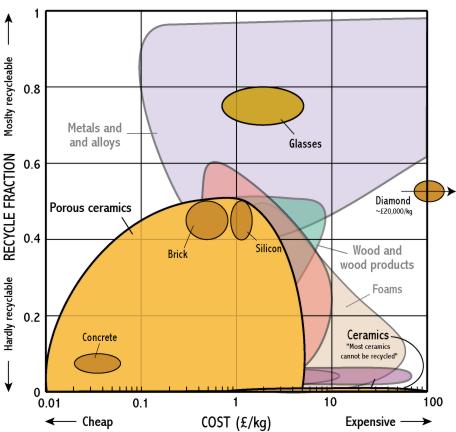
Thermosets cannot be reshaped leading to low levels of recycling, and ceramics are almost never recycled
Example Uses
If disposable items cannot be made from sustainable materials , recycling options should be considered
As packaging is used only once, environmental design can be achieved by making it reusable or recyclable
At present a very high fraction of every car is recycled - changing to composites or complex alloys could make them less recyclable.
Bricks are often re-used, and building rubble is recycled as hard core.
Simple Questions
Why is brick heavily recycled?
Brick and other building materials are easily recycled during demolition, either to be used instead of new bricks, or broken up and used as hardcore. Bricks take considerable energy resources to make and thus are economic to recycle.
How is steel separated from other metals for recycling?
Separating materials for recycling is a real problem. It is not difficult to remove ferritic steels using (unlike stainless steels which are non magnetic).
Select materials for a disposable cup.
Ideally a sustainable material such as paper, but if not then a disposable cup which uses as little material as possible since recycling is very difficult. Ideally a plastic which is biodegradable.
Select materials for a pizza box.
Thermal insulation and protection of the product are of primary concern. Paper (cardboard) meets these requirements and has the added benefits of recycled product, or being biodegradable and sustainable.
Select materials for a car body.
A number of options are available, steel, high strength alloy steel, aluminium, plastic and composite panels. The steel panels have the advantage that they are already heavily recycled. Composite panels would be very difficult to recycle and the high alloy steels might make recycling more difficult.
Further Questions
Why are aluminium drinks cans heavily recycled despite their low weight?
Ink jet cartridges are good examples of disposable items which are best reused rather than recycled, can you think of others?
There are 2 separate populations for this class to improve clarity. Move the mouse over different parts of the class name to reveal each one.
Rollover class name to view individual materals, click chart to return to class view. Hover mouse over property for brief definition.