Please wait while page loads... This should be < 1 minute on a 56k modem
Strength - Elongation
General Information
Physical Insights
Example Uses
Simple Questions
Further Questions
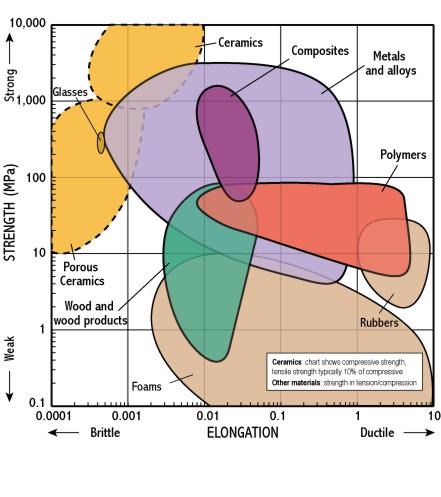
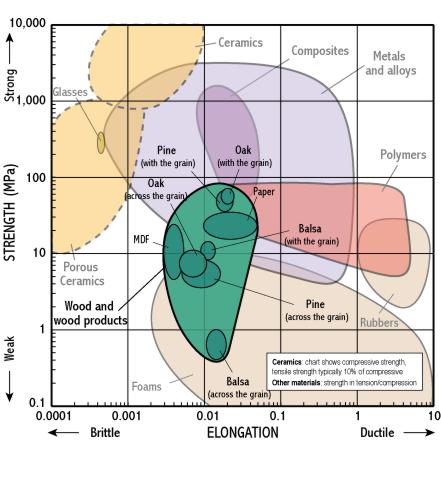
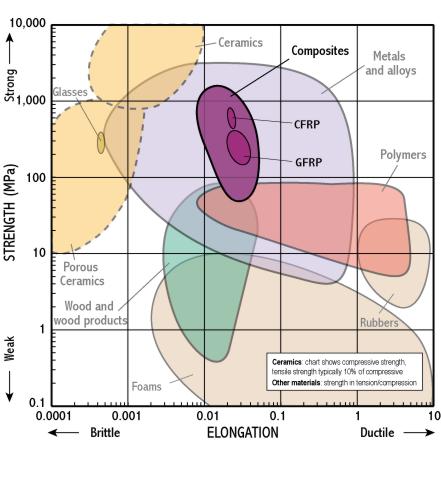
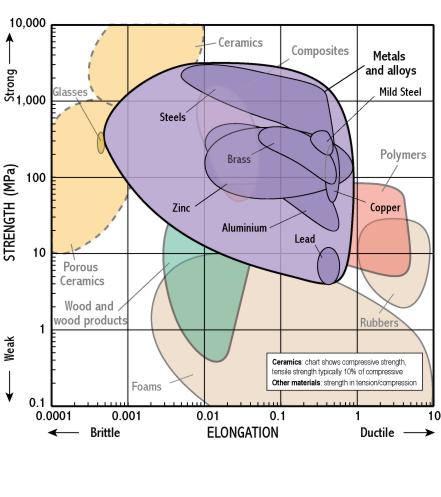
This chart helps select materials that can carry a high load before permanently deforming and can 'stretch' a lot before breaking.
General Information
Strength measures the resistance of a material to failure, given by the applied stress (or load per unit area).
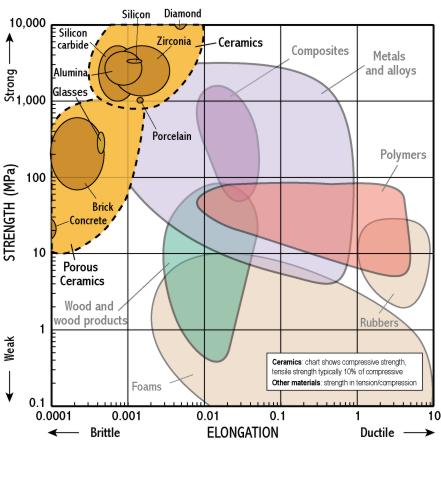
The chart shows yield strength in tension for all materials, except for ceramics for which compressive strength is shown (their tensile strength being much lower).
Elongation measures the percentage change in length before fracture
Elongation to failure is a measure of ductility.
The 'hardness' of a material is often used to indicate things like wear resistance. Hardness is
measured by making a small surface indentation. It is not a material property, but is closely
related to the strength, so strength gives a good indicator of wear resistance.
Physical Insights
Ceramics have very low elongations (<1%) because they can not plastically deform.
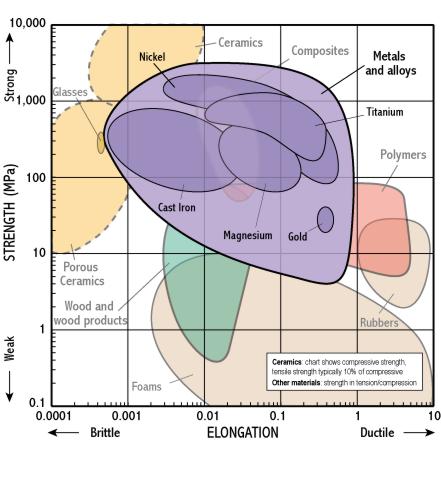
Metals have moderate elongation to failure (1-50%) with deformation occurring by plastic flow.
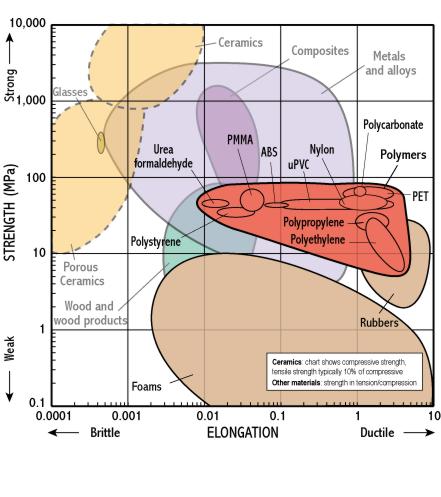
Thermoplastics have large elongations (>100%) because the molecules can stretch out and slide over one another.
Rubbers have long elastic elongations because the chains can coil/uncoil elastically.
Thermosets have low elongations (<5%) because the molecules are cross-linked together into a network so that they cannot slide over one another.
One way to strengthen a metal is to make plastic flow difficult – this reduces the ductility and elongation.
Example Uses
Few components are designed to elongate significantly - crash barriers for impact protection are one example.
The chart helps identify materials which can be easily deformed into new shapes during manufacturing.
Designers like to use metals with significant elongations to failure because they are more forgiving of harsh treatment, e.g. car chassis, nails.
Simple Questions
What is the difference between elastic and plastic deformation?
Elastic deformation is reversible, i.e. when the load is removed the distortion disappears. Plastic deformation leaves a permanent shape change. Usually elastic deformation is proportional to the applied load.
Why is lead used on old roofs and roof flashings?
Because it is corrosion resistant and is very easily formed into shape. Because lead has almost no elastic deformation and a large plastic deformation, it can take up the contours of any roof thus keeping out water. Elastic materials show a spring back which must be taken into account when forming (e.g. car body pressings).
Select materials for a car bumper.
Must be able to take low speed impact (<10km p h) without damage, while helping to absorb some energy at higher impacts. Original chrome plated steel (which damaged easily), now either rubber or ABS.
Select materials for a bungee rope.
Clearly here large elastic elongations are necessary so that rubber is ideal, often reinforced with nylon threads to prevent catastrophic breakage.
Select materials for drawing pins.
Either made of steel or brass and formed by cold deformation.
Further Questions
Why can’t rubbers be formed into shapes easily, even though they can be subjected to large deformations?
There are 2 separate populations for this class to improve clarity. Move the mouse over different parts of the class name to reveal each one.
Rollover class name to view individual materals, click chart to return to class view. Hover mouse over property for brief definition.