Case Study - 13A plug
Choosing the right materials at the right price
Component designers do not become rich by choosing unnecessarily expensive materials! So as well as considering the electrical conductivity when choosing materials, we also need to consider the cost. What's the easiest way of considering cost at the same time as making sure we have suitable conductivity?
One way of selecting the best materials would be to look up values for the conductivity (or values for the resistivity - its opposite) in tables for various possible materials: good conductors would have low values of resistivity whereas good insulators would have high values. From a list of suitable materials we could then choose those which are fairly cheap.
However, this method is time consuming and the designer may miss materials which they simply forgot to consider. A much easier method is to plot materials on a chart of electrical resistivity against cost...
Interpreting material selection charts
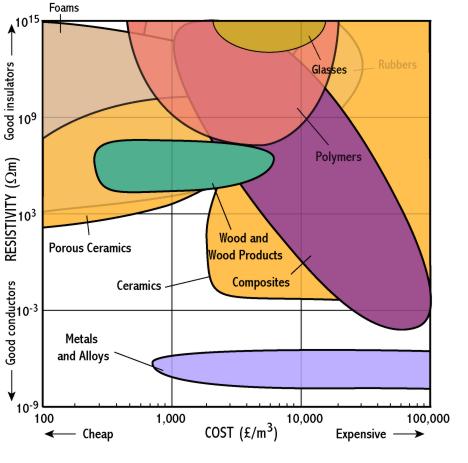
Polymers are good insulators and not too expensive
Metals are the only good conductors!
Cheap conductors lie nearest to this corner
Cheap insulators lie nearest to this corner
|
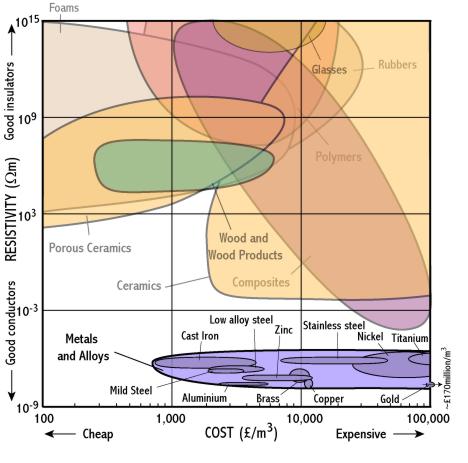
This kind of graph is called a materials selection chart. Note how materials of each class (e.g. metals) form clusters marked here by the shaded regions. The chart makes it easy to identify cheap conductors and the cheap insulators.
We can now see why:
- most of the non-conducting parts in the plug are made from polymers
- all the plug components requiring good conductivity are metallic and, by expanding the chart, which particular metals might be most suitable
|
But, this isn't the whole story...
At a simple level, the chart shows why most of the material classes found in a plug have been chosen (polymers and ceramics for the insulating parts and metals for the conductors). But could other material classes have been used and why were the specific polymers and metals chosen that are used in practice? For example:
- Why wasn't wood chosen for the plug cover?
- Why isn't copper used for the plug pins?
Of course one chart cannot tell the whole story: we need to consider other properties and also how to manufacture the parts of the plug. Let's consider in more detail one insulating part - the plug body - and one conducting part - the pins.
Next 
 Previous