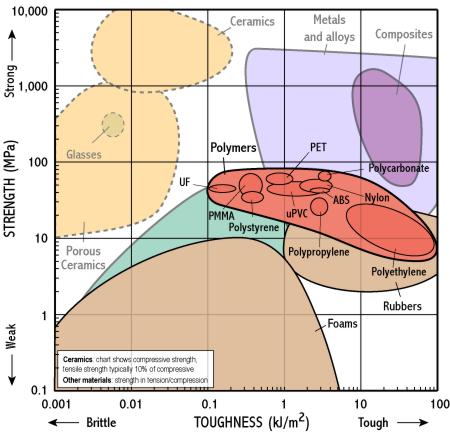
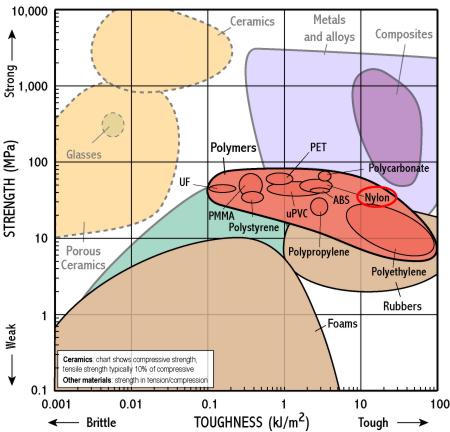
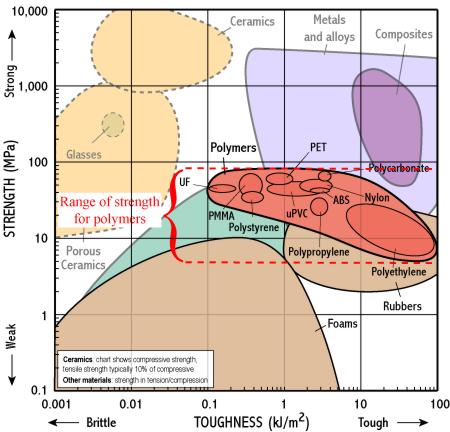
To hold the pins securely and to protect the conducting parts, the plug body must be sufficiently strong and stiff. Plugs are also likely to suffer impacts, so toughness may also be a factor in material choice. A materials selection chart showing strength against toughness for various materials allows us to compare various polymers and we might be able to see why other polymers are not suitable.
Plug body: two different solutions
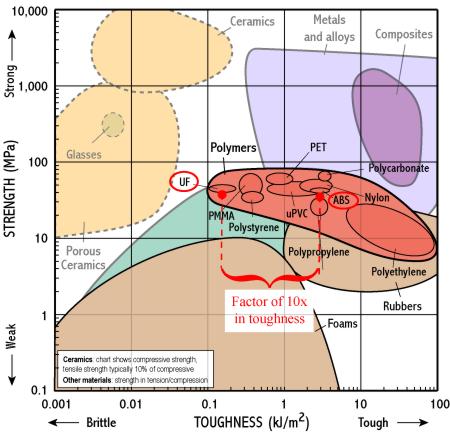
Although both ABS and urea-formaldehyde are used for plugs, they are in fact used for slightly different applications. In addition, ABS is used for one piece moulded plugs which prevent access by the user whereas urea-formaldehyde is used for two piece plugs that can be fitted by users. From the selection chart and processing information we can see why:
- ABS is used for one piece plugs because thermoplastics can be easily joined after moulding. ABS is also much tougher and as a result is ideal for pre-fitted plugs which might suffer impact during service (e.g. vacuum cleaners).
- As a thermoset, urea-formaldehyde is stronger (and stiffer) than ABS so it is ideal for a two piece construction where each half must be individually stronger. The lower toughness means that urea-formaldehyde plugs should only be used for fixed appliances where the plug is unlikely to suffer impact (e.g. computers or freezers)
Next 
 Previous