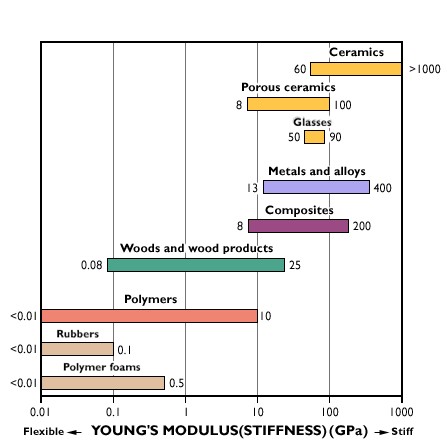
Young's modulus measures the resistance of a material to elastic (recoverable) deformation under load.
A stiff material has a high Young's modulus and changes its shape only slightly under elastic loads (e.g. diamond). A flexible material has a low Young's modulus and changes its shape considerably (e.g. rubbers).
A stiff material requires high loads to elastically deform it - not to be confused with a strong material, which requires high loads to permanently deform (or break) it.
The stiffness of a component means how much it deflects under a given load. This depends on the Young's modulus of the material, but also on how it is loaded (tension, or bending) and the shape and size of the component.
Specific stiffness is Young's modulus divided by density (but should more properly be called "specific modulus").
Design issues
Stiffness is important in designing products which can only be allowed to deflect by a certain amount (e.g. bridges, bicycles, furniture).
Stiffness is important in springs, which store elastics energy (e.g. vaulting poles, bungee ropes).
In transport applications (e.g. aircraft, racing bicycles) stiffness is required at minimum weight. In these cases materials with a large specific stiffness are best.
Measurement
Tensile testing is used to find many important material properties. The compression test is similar but uses a stocky specimen to prevent bending.
Units & Values
Young's modulus is equal to elastic stress/strain. Strain has no units to the units are the same as stress: N/m2, or Pascals (1 Pa = 1N/m2 ; 1 GPa = 1000 N/mm2)
Specific stiffness (more properly called specific modulus) is Young's modulus/density - it is mostly used for comparing materials so the units are not important.